Showing posts with label strategy. Show all posts

Tuesday, 20 March 2012

5 in 4

Pop quiz, hot shot! You've got 5 two-player games and an afternoon to kill. What do you do? What do you do?

The answer? Go and visit David Q. Smith of Mondo Comico fame and play the heck out of them. So here are 5 games we played in (just under) 4 hours.


13. Star System

by Walter Obert
Players: 2
Ages: 9+
Time: 30+ minutes
Type of game: Deductive Card Game
Recommended?: No


 A Cluedo/Guess Who? type game. Be the first to work out which 5 of 20 stars are featured in your opponents movie. Although why he's trying to keep it a secret is beyond me. Not my favourite hidden information game which is why it's now on the shelf of Mondo waiting to be sold!


14. Lord of the Rings: The Duel

by Peter Neugebauer

Players: 2
Ages: 10+
Time: 45+ minutes
Type of game: Hand management
Recommended?: Yes

The fight between Gandalf and the Balrog played out with cards. Exactly turn you must play a card. You shall not pass! Ahahahahahaha! How funny I am.


This is fantastically over produced with Gandalf and Balrog represented by odd little wooden pieces and a lovely cardboard bridge is included to walk them on to represent who has the upper hand at any one time.


Each card has four slots on each side. An filled slot is an attack, an empty one is not. Your opponent plays a card and them you must answer it. Any filled slots that are unanswered by another filled slot means 1 damage to the opponent.

You will play with every card in the deck during the game so you need to make sure you don't use all your best cards up-front.

15. Pick & Pack

by Simon Hunt

Players: 2
Ages: 8+
Time: 20+ minutes
Type of game: Light Abstract Strategy
Recommended?: Yes
A fun little apple collection game where you and your opponent operate a claw grabber like in those fairground machines that contain awful stuffed toys that you can never win because the machine is fixed (or for readers in Japan - UFO Grabbers that contain cool toys and actually give you a very good chance of winning.)


The twist is that one of you controls the horizontal movement on their go as the other moves vertical on theirs. So you've got to try and get something good while denying them on their turn. Or... do you set them up with something so appealing that they'll set you up for an even better tile on your next go.


Beyond the core tiles you have action tiles that can be triggered by landing on an empty space. These can increase the value of your apples or decrease the value of your opponents allowing you to pip them to the top spot.

I've run out of apple gags now.

16. Strike Dice

by Michael Andresakis and Alexander Argyropoulos

Players: 2-4
Ages: 8+
Time: 20+ minutes
Type of game: Random Abstract Strategy
Recommended?: No


Gah.

Full disclosure: I play-tested this game and helped to re-write the rules (as in, make them clearer not change them).

That said, despite being emotionally invested in this and having real respect for the visual attention that these guys have given Strike Dice and their other game, Eragra, I struggle to say many positive things about this game.

An abstract strategy game with pawns of random strength. This unbalances the game so much that it becomes way more about luck than strategy.


The rules are still wilfully obtuse and over-written making a relatively basic game seem complicated and deep at first glance.

Good luck to them but I won't be keeping it.

17. Stratego: Star Wars

by Jacques Johan Mogendorff / Uncredited
Players: 2
Ages: 8+
Time: 30+ minutes
Type of game: Secret movement
Recommended?: No

Classic Stratego with a twist of Star Wars Episodes 1, 2, 4, 5 and 6. That's what happens when you make a game midway through a prequel trilogy.

Yours and your opponents pieces are hidden from each other until one attacks the other. Then the pieces involved in the combat are revealed to decide the outcome. The loser removes their piece from the board and tries to remember the location and type of piece in order to make a succesful path to the enemies hidden goal piece.

With certain pieces that work against each other best (think you've found a bomb? You need a droid to defuse it) your brain will be twisting and turn to keep track of what's where.

Unless you're me with my limited patience for abstract strategy games in which case you'll kamikaze charge your way to certain doom.

And yet... I think this might stay. David Q. Smith talked very fondly of playing this as a child and a game like this would be good to have in the house when I finally have children. Because surely I'll be able to beat them at it!


I've weirdly forgotten who won what... Perhaps David remembers.

Tuesday, 28 February 2012

Riskier Business - Spoiler free zone

10. Risk: Legacy

by Rob Daviau and Chris Dupuis

Players: 3 - 5
Ages: 13+
Time: 60+ minutes
Type of game: Family / War
Reccomended?: Yeh

Risk: Legacy is somewhat controversial.

After all, here is a game that you destroy over time. You will rip up cards, not remove them and put them in the box. You will write on your board with a regular pen not with a wipe clean pen. You will stick stickers on your board and onto cards that will change the way the game plays. Forever.

Except... This is actually a game that you build over time. Eventually, after 15 games or so, you will have a unique game that provides you with a visual reminder of the skirmishes that have come before. It may not be the most balanced game in the world but you'll take that into account when playing. After all, standard Risk isn't balanced because the world isn't balanced and neither will your new world be.

Playing regular Risk gives you an idea of what to expect here.
The board and the starting rules remain pretty much the same. There's a variance in claiming a card if you successfully conquer a country that adds a little more strategy and should get the game moving faster but, aside from that, so far so similar.
Beyond that base the game very quickly shows some new aspects.

The box

Hidden between the (slightly nerdy) future war cover is a carefully thought out thing of beauty.


The box is sealed with a sticker you must break in order to open it. Not only guaranteeing that nobody has "built" your world before but also reminding you of the permanence of what you are about to start.

Opening like a briefcase, you're greeted by some sealed packages and a sealed board that, again, reminds you that this game is a war. A war that you will fight and, win or lose, you will accept the consequences of your actions.

Sign and be damned!

Beneath the board lie the 5 armies and 2 extra sealed compartments ready to spread fresh havoc in the future.


Hidden beneath the components tray lies the sneakiest component I've ever seen. Do I want to open it? Yes! Will I open it? Maybe...

Armies

Gone are the cubes and beads of old school Risk. Here we have 5 different armies. Not only do they look different (which shall I have? The ones riding the bears or the ED209 knock-offs?) but they also play differently. Again, how they play comes down to you.


At the beginning of the 1st game you select an army. You also get a card with 2 distinct power stickers on it. You choose one, stick it to your armies card and throw the other one away. That's it. Gone from the game. Forever. As the game progresses more powers may become available to you making your army pretty unique.
Although you choose an army in that 1st game it doesn't mean you have to use them forever. You can chop and change depending on what's available and how tasty the powers on offer are.

Resources


Instead of receiving a random resource card upon conquering a country you can get one if you conquer a country whose card is showing on the resource board. These cards can range in value from 1 to 6 and, providing you have enough, be turned in at the beginning of your turn for more troops. If none of the countries you conquered are on the resource board you get a measly little 1 resource card.

Throughout the game you can add resource stickers to your favourite country cards to make them even more valuable. Beware! If you make it too valuable somebody may decide to destroy it at the end of the game because of the unfair advantage it gives you.


Scars


At the beginning of each game, each player gets a random scar that they can stick to a country on the board should they wish to. At the beginning of the game you will have either a bunker, for better defence, or an ammo shortage to weaken defence. These can sway they tide of battle but, as you only get one each game, need to placed carefully to ensure maximum impact.

The board holds handy reminders of what the scars do and has places for future scars that, presumably, are included in the extra packages.


Rules


Event the rule booklet doesn't escape customisation. As you progress through the game you will find stickers to place in the rule booklet that change or add to the established rules.

Win (or live through) a game and you get the chance to add or remove something in the game. This could be as simple as adding a resource sticker to your favourite country...

...or as founding and naming your very own city in your favourite country.

Envelopes

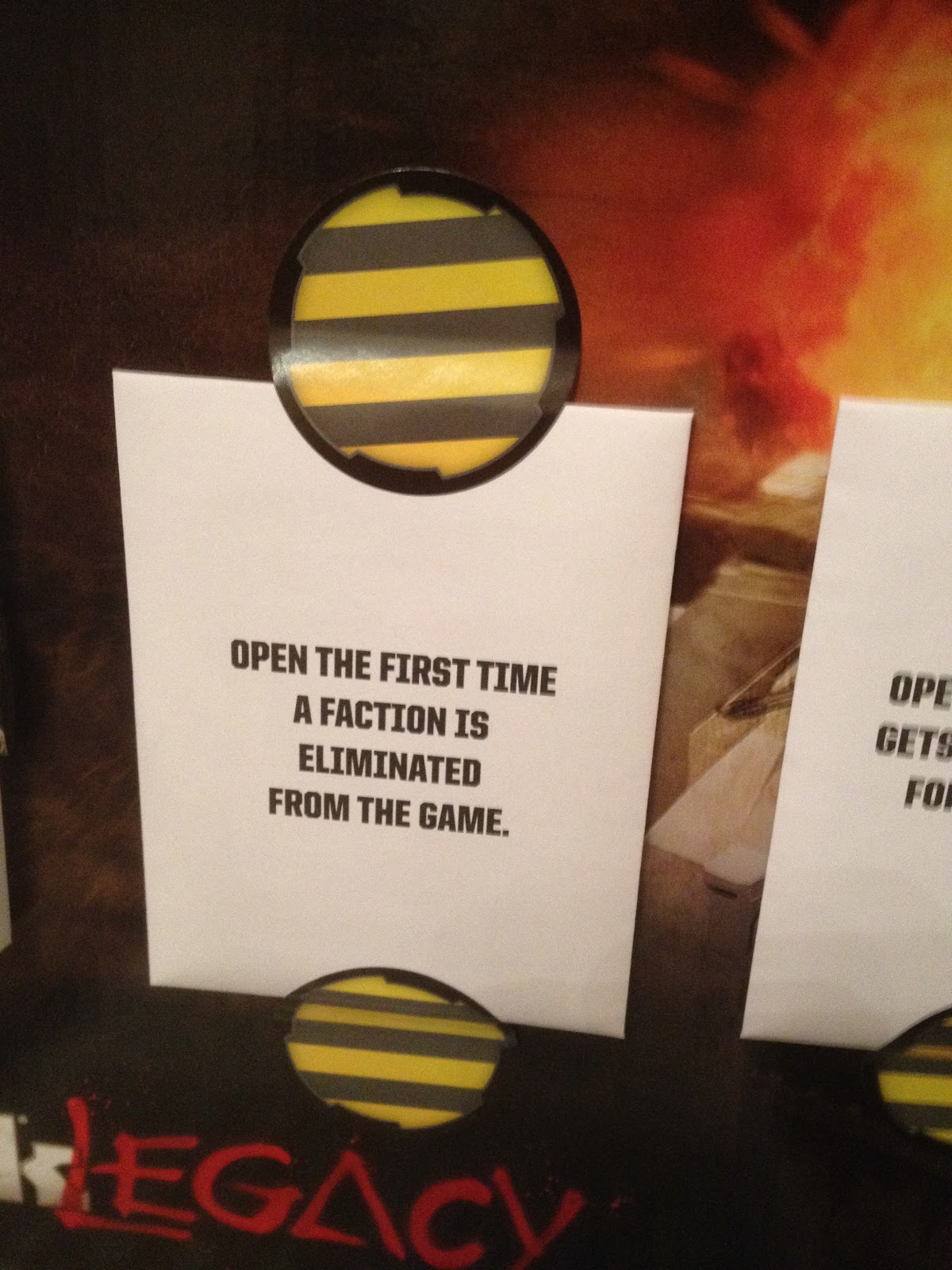
We've opened one envelope so far due to my Risk rubbishness. I'm not telling you what was inside but at least it gave me something to read while the game finished.

I'm 1 game in so far with Risk Legacy with (at least) 6 hidden elements yet to come into play. The shape of the game is yet to be decided and I can't wait to see what it will finally be.

Monday, 6 February 2012

Sabre-toothed Seven

8. Mammut

By Kristian Amundsen Ostby

Players: 2 - 5
Ages: 8+
Time: 30+ minutes
Type of game: Social / Auctionish
Reccomended?: Yes

Seems like life in prehistoric times was a little more straightforward than it is now. You'd go out with your tribe hunting and gathering then split the spoils under the watchful eye of the tribe leader. Everyone shared the work and got their equal share of the spoils. Fair. Y'know, exactly like banking works now.

What if the tribe leader wasn't around and we were left to ourselves to decide how to split it? What's to stop me taking all of it? We need some rules to stop that happening. Let's see... If I have nothing in front of me I can take as much as I want from the central pile or take everything from somebody (who either has been too greedy or has what I want).

Seems fair? That's Mammut.


Here's the 2 boards. The far one acts as storage for the 7 sabre-toothed animals and a reminder of the various scoring options, the other is for keeping track of your score and furs.
You get thin and fat mammoths to mark your journey and another one to keep in front of you to:
A) remind yourself what colour you are
B) remind the other players what colour you are
C) play with
During the game you will find yourself doing mostly C.


Each round you'll upend a bag of tiles and leave them as they fall apart from separating them slightly so you can see what side is up. The first player takes what they want but tries to take little enough so that it's not stolen by another player. In our game 7 was decided as being the amount you could take without being acutes of being too greedy. Which meant we'd take 8-9 to try and push our luck.
With a number of ways to gain points and a couple of ways to lose points, you've got to get a good mix and keep an eye on what your opponents are picking up. But, as the tiles are double-sided you can never be certain of what you're going to get each round. So, although you can decide on a basic strategy you've got to be open to changing it.


Like The Resistance, the bulk of this game happens socially. Yes, you have the tokens in front of you to represent the choices you're taking but it's how you argue the fairness of those choices that really makes the game. That's where the fun of this really comes into play.

Also, there are sabre-toothed hamsters in this game.

Friday, 27 January 2012

You Sank My...

7. Battleship Express

By Reiner Knizia


Players: 2 - 4
Ages: 7+
Time: 10 - 20 minutes
Type of game: Dice
Reccomended?: Yes


Battle Yahtzee!
Reiner Knizia!
You Sank My Battleship!
All Games Will Come in Pods In The Future!
Express!


Line up your fleet. Choose one to attack with and then pick one of your opponents fleet to attack. Roll your dice as many times as your ship will allow hoping that you get enough successes to sink their ship. If you succeed you get the ship as a trophy.Get enough trophies and you've won the war.

Comes with Simple (Captain) and Quite Simple (Admiral) rules.

The only thing this has in common with the traditional Battleship game (C3? Miss. D12? Miss? B4? Miss? Ad infinitum) is the theme. This is not a bad thing in that this game is not dull.

Great little luck-based light strategy game to kill 20 minutes. Highly recommended and pretty cheap.